

This is a First Person Long Read – the first, one liberty I am taking as the creator of the Brexit Lived Experience Archive (BLEA). The Long Read positions BLEA but also looks at the bigger picture of a decade of anti-immigration politics in the UK that the EU referendum essentially helped normalise.
The Brexit referendum has always been personal – and so is its legacy 10 years on
I fell in love with this country and came to it again and again – for holidays, for volunteering, to improve the language – even before I ever lived here. Then the country voted to be rid of people like me. I spent a decade collecting the record of what that cost.
Tanja Bueltmann
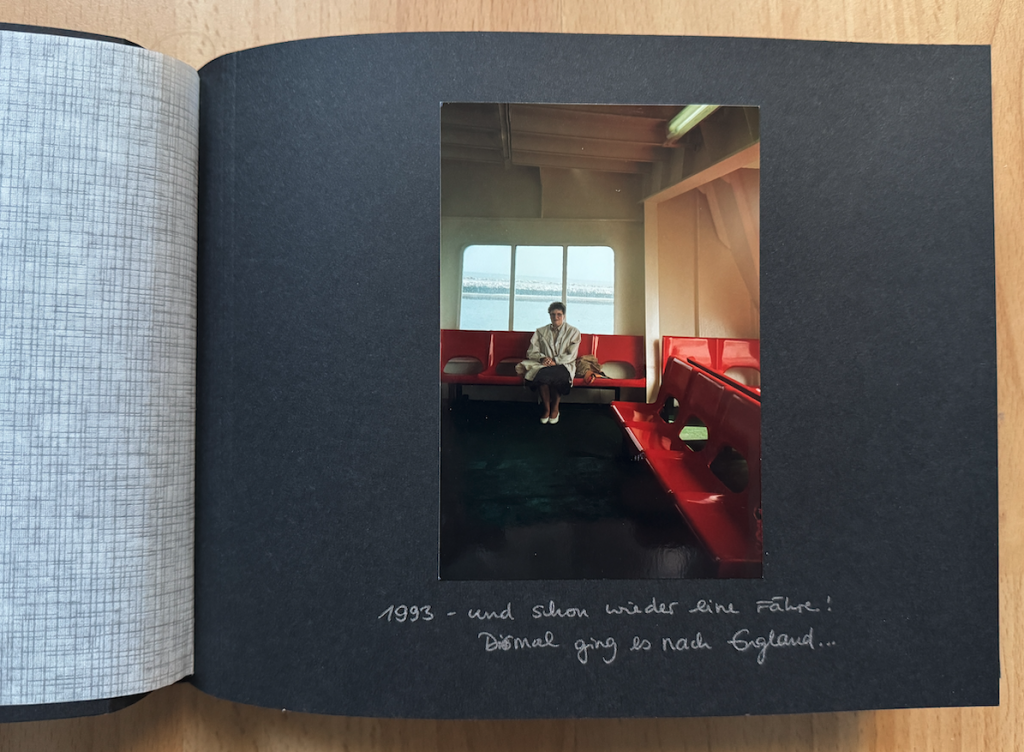
The first time I saw Britain, I was a girl on a ferry, and I took two photographs of that first view. This was the early nineties, long before smartphones. The film in my little Kodak held a fixed number of shots, each one earned, counted out against the chance of something better further along. So I waited, and when the White Cliffs of Dover emerged in the distance, I took my first shot.
My grandmother was with me. We travelled together once a year, just the two of us. In a working-class family from Ostwestfalen, the corner of Germany I come from, this was its own small act of defiance. My father’s idea of abroad is Bavaria; my mother loves the German coast. And so it was my grandmother who took me out into Europe before I was old enough to go alone. She opened the door – including to the UK.
What waited on the other side I had already half-invented. We learned English from a textbook called Red Line, one chapter in the then current volume covering a trip to London. So I arrived well-primed and London obliged. Cool Britannia was just getting into full swing, and the place felt more vibrant, more open, than anything Germany had shown me. Without quite deciding to, I was smitten. It was nothing rational. Even as a teenager I could see the infrastructure was older than at home. The beds had no proper duvets. There was no mixer tap in the bathroom – sorry, I will never get over that!
I want to be careful about what I am claiming, because a teenager’s crush on a country is an easy thing to sentimentalise. But there is a serious point underneath my story.
I was not born in this place. I came to it across a sea, on purpose, again and again: summer trips to Bournemouth, volunteering in an old people’s home in the South East of England and then in Scotland; eventually a university place. Each return was a small renewal of my choice for the UK.
And I have come to suspect that a country you choose like that can have a deeper hold on you than the one you are simply issued at birth. You notice it more, a choice. Especially because you could always have chosen differently.
Except that one place perhaps turned the tables on me. Maybe Scotland chose me. That is how I often think of it. I had driven up from the ferry port outside Newcastle upon Tyne, on my way to Scotland to volunteer in a home for disabled people in Edinburgh for a year – a voluntary gap year after my German Abitur. And the first thing that happened when I arrived, before I had even set down my bag, was that a resident I had not yet met put her arms around me as though I had been expected for years. It sounds too neat to be true, but it is true.
From that hug Scotland was home. Everything followed from there: my Erasmus return as a student, the accidental path into Scottish history that made me the migration historian writing this now. That is how I came to love this country.
There are millions more stories like mine, each distinct. And in 2016, all of them collided with the same event: the UK’s EU referendum.
In the decade since, I have spent my working life studying how people make homes in places they were not born in. How belonging is built, what holds it together, and what makes it come apart. And I have spent it in archives, which has taught me something that bears directly on this anniversary: history is not written by the victors so much as by the documented.
The migrant generations we can still hear today, the ones whose grief and adaptation and stubborn hope survive, are the ones who happened to leave letters, diaries, association minutes, words on paper that someone thought to keep. The rest fall silent, and their silence is then mistaken for contentment, or for absence, or for nothing having happened at all.
Every period’s official record is generous to the state that produced it. So for Brexit, the Home Office will leave behind its statistics, scheme dashboards and press releases announcing success. And unless we keep the other record – that of the actual lived experience – that is the version the future will read about the experiences of EU citizens like me who chose the UK as our home and that Brexit sought to cast out.
Keeping that other record is what the Brexit Lived Experience Archive – BLEA – is about.
Through the long administration of leaving the EU, I built the archive this piece draws on. At present, it includes data from one survey but I have two more datasets to add and I hope to be able to do so as soon as possible. This includes one dataset from British citizens in the EU – this story has always been one that cut across the both groups. In total, BLEA will – assuming I can continue to build the archive – contain likely close to 750,000 words worth of EU citizen / British citizen in the EU testimony, spread across around 7,000 respondents. The present version, BLEA 1.0, contains approximately 300,000 words from just shy of 2,500 respondents.
I had not foreseen such an uptake and, from a purely research-focused perspective, such response numbers are not necessary. More crucially, the huge volume of data has made it, in many ways, quite impossible to fully do justice to them.
That is why I am now building a public, searchable archive of the testimony itself: not a dataset locked to one researcher, but an archive that documents experiences, supports understanding, and preserves memory.
Several books’ worth of Brexit primary source material provided through the lived experience of EU citizens who used the surveys in this way because there was nowhere else to put their feelings. Many respondents were, as one put it, ‘very grateful’ for the survey because it was ‘giving EU citizens a chance to talk about how Brexit has impacted our lives.’ Others found it ‘therapeutic’.
Of course I was also reading what impacted my life. When I began to read, I recognised the pattern before I was through the first hundred entries. I had seen such types of evidence in the archives from other countries and earlier centuries. But I had simply never expected to watch an archive being made, in real time – and by people I am one of.
The important day is not 23 June 2016, it is 24 June 2016.
The first thing that went that day was the feeling of being safe in public. A woman at a bus stop, speaking Polish to her daughter, is told to stop: ‘we are in England’, a passerby said. Another respondent was ‘anxious using [her] language in public’, while a mother recounts how she stopped speaking her own language to her children because she does not want them to learn, this early, what it is to be hated. For others, ‘Brexit made [them] afraid of saying’ where they come from.
Yet these are often people who could not be more integrated if they tried, from accounts of having always loved the Wombles to still knowing the UK’s 1997 Christmas number. The rupture the EU referendum caused was, for one respondent, like ‘a mark on my forehead’ and one again tied up with language: ‘I would be much less comfortable walking down the street talking to my mum on the phone’, she said. I’ll come back to that point.
Some post-EU referendum experiences were considerably more severe, revealing not only words and looks, but more concrete actions. One woman’s home was pelted with eggs, and later attacked with bricks. ‘I am lucky to be alive’, she wrote. These are family, friends, neighbours and colleagues, like all immigrants. What they discovered after the EU referendum vote is that, to many in the UK, their being here had been little more than a tenancy, and the lease had just been cancelled.
You can watch the self-image of EU citizens come apart, line by line.
Brexit ‘has marked me as “other”, one wrote, ‘when I felt totally integrated before’. Nationality, another explained, ‘was completely unimportant up until a few years ago. No one cared’. Another respondent, after twenty-six years of living in the UK expressed it in terms many other respondents also used: ‘I feel like a second-rate citizen, having to justify my existence here’. Others recorded the same sense of demotion in different words: ‘I am being tolerated rather than accepted’.
Even those who still felt at home nonetheless found, as a Frenchwoman expressed it, that ‘I constantly worry about people judging me for having a French accent or name, and my personality has changed dramatically. I am much less outgoing’. Brexit reached inside people, changing how they see themselves.
The welcome splits in two, offered with one hand and withdrawn with the other: ‘it’s not about you, you’re alright, it’s the others’. Many respondents recount being told this line, all making clear that it does not work at all. ‘How do British people really see me then’, one respondent asked. Running underneath it all is a real sense of grief and loss.
The damage reaches into futures people had already written in their minds.
One woman had put it in her will that she wanted her ashes scattered in the Yorkshire Dales; after the referendum, she wrote, she could not even ‘see [herself] retiring here’. A man of nearly fifty years’ residence, forty-five of them married with two children and five grandchildren, compressed that half-century into one very clear image: Brexit had ‘disturbed’ his ‘roots’.
Then it reaches the relationships, which is where the archive sheds light on the depth of disturbance. A family of four, all on the same passports, comes out of the EUSS, holding four different statuses, now unable to use the same passport line. A daughter, meanwhile watched the result of the referendum ‘tearing my family apart’. A woman finds that her partner’s own family voted for Brexit, leading here to conclude that she does not ‘feel welcome anywhere’ now. For others, friendships simply stopped.
One sentence has been stuck in my mind for some time. Brexit, a respondent observed, ‘has turned a love into loathe’. I began by telling you I fell in love with a country. I was not the only one. And these lived Brexit experiences chart what it costs when that country files for divorce.
Official numbers hide these consequences.
The EUSS, by its own measure, worked. Most people who applied got what they asked for and, in that sense, secured their status. But the very fact that they had to apply to stay in what already was their home explains a lot about the sense of rupture so many express in their responses. It is possible to process someone with perfect efficiency and still inform them, in the doing of it, that they do not belong.
One German respondent found the face-scanning of the application ‘eerily familiar from history lessons’. Another summarised the underlying contract as she had come to understand it: ‘if they had it their way we would only be allowed to contribute to the system but not be allowed to have any rights. We are expendable and only tolerated.’
And we must also remember the stories that EUSS statistics hide: for a significant proportion of EU citizens, the application process did not go well – a fact one barely hears about. This has never been a malfunction: it was the design functioning as built, ensuring the removal of as many EU citizens as possible even through the scheme. The wider ramifications will continue for years to come, and I stand by my earlier view that we will see a new kind of Windrush generation. We already have too many examples of it.
The sense of rupture has not faded over time.
I ran another survey a few years later – it is this survey that is available in BLEA 1.0 – partly to find out whether any of these view had faded with time. The way many commentators assumed they would. This is not what happed. What once was an acute wound had become a chronic condition whose defining symptom was a single word: trust – and the absence of it. A lack of trust in the EUSS, but also the UK Government. As one respondent of that second survey explained, they ‘need a cast iron guarantee that my status will not be downgraded at the whim of any government in power.’
There is also a growing sense of the whole situation being an insult. ‘I am still awaiting an apology’, said a respondent,‘for being called “queue jumper” and “citizen of nowhere” from the government I have been supporting with my taxes for over 20 years.’ A government can restore a right, though in this case that right itself now has limits it did not previously have, but it cannot legislate back the trust. Once that sense of safety is gone, a person lives provisionally in their own home for the rest of their life, no matter what document they hold.
The wider impacts of these experiences are not well known in wider public discussion.
The rupture spread outward from the EU citizens it impacted, and into exactly the civic fabric that immigration debates claim to prize. I had asked about community involvement. People had stopped. One respondent had given up the school association, the playgroups, her volunteering. She simply observed: ‘I do not wish to have to give help or support to people who voted to kick me out of my home.’ The candour of another respondent who made a similar decision has stayed with me: ‘Brexit made me more selfish. I feel the need to fight my corner and I lost a lot of compassion. I don’t like being that person, but I don’t think the process is reversible.’
Even the word at the centre of every immigration debate—integration—was no longer enough. As one respondent, who had done everything the word ever asked, from learning the language, to supporting neighbours and local festivals, concluded that ‘integration is now a term used by xenophobes to keep moving the goalposts further and further, to justify pretty arbitrary exclusions’.
The Labour Government is formalising this in a way even I could not have imagined, establishing social contribution requirements. Irony really is dead in this respect: here is a country that continues to lecture immigrants about integration, legislating for ever more impossible measures, when it also ran a project that drove some of its most integrated immigrants to withdraw from common life.
That is why, for a significant proportion, the only move left was to leave. But the leaving is not triumphant, it is grief in the clothes of a decision. A woman preparing to leave said that the country had ‘robbed [her] of [her] beautiful home, robbed [her] of feeling safe’.
For those who stayed, the damage settled in their sense of belonging. As one respondent explained, ‘I find it hard to see myself as an integral part of British society’ following Brexit, ‘but at the same time I feel like I wouldn’t be able to integrate back home, as my life and experience in Britain have irreversibly changed me.’ Another simply stated ‘I currently have no home.’
These experiences are not, however, evenly distributed across the map of the UK.
The voices from Scotland sound different, though not untouched. The Scottish government, one respondent wrote, ‘went through great effort to make me feel represented’. Now the right to vote in all Scottish elections continues that trajectory; prior to Brexit, personal letters and public statements made a significant difference.
The only comparable experience lies with EU citizens in London who similarly praise the Mayor of London. But even there the ground had shifted: while a strong sense of belonging remained for some, ‘the years following the vote have felt like a long drawn out goodbye’.
The hostility was a policy. The welcome, where it existed, was a policy too.
Which brings me to the strangest finding of all, and the one that cuts closest.
You would expect people treated this way to want nothing more to do with the country’s citizenship. The opposite is true in many respects: by 2021, large numbers were naturalising if this was an option available to them. But almost no one was doing it for love. The view of one respondent encapsulates those of many: ‘in 2015 [applying for British citizenship] would have been because I actually felt British […]. In 2016 I felt very much “other” and unwanted.’
Those who applied were doing it as insurance. Against the government, against the next rule change, against the digital status that might fail at a border. They were approaching British citizenship the way you approach a lock for a door. And the state, for its part, made sure the lock was expensive.
The infamous Life in the UK test is described a ‘jingoistic exercise about Britain’s alleged grandness’. One applicant describes being searched with a metal detector, having her hair and ears checked for devices, sitting the test with her sleeves rolled up, and watching a supervisor shout at an old man whose computer would not work. It was, she wrote, the ‘hostile environment at its full display’. Precisely how so many immigrants had already been experiencing it for a long time – everything but welcoming and, for too many, racist at the core.
The cost of this shows up most painfully at the moment that is supposed to be a celebration. One woman described her citizenship ceremony, the flag, the oath, the photograph, as what should have been ‘a moment of pride and joy. Instead it was laced with bitterness and resentment. I felt so robbed.’ Another drew the distinction that our leaders at the despatch box never could: ‘I think in English, dream in English, I identify with British arts and culture; in that sense, I don’t actually think Brexit is British at all; it’s an aberration.’
There is a great deal of harrowing evidence across the data.
And yet the line that undid me personally was a mundane one from the first survey (not yet integrated here). Asked simply where they had made their EUSS application, a respondent named a KFC branch in an English city. I read it and burst into tears. I have thought a lot since about why that line, of all of them, was the one. I think it is because it held, in a single very ordinary image, everything that was so wrong with what was being done. A person reduced to applying, across from a fast-food counter, for the right to continue living in a home that was already theirs. Anxiety and humiliation accompanied by the smell of deep-fried chicken.
It was perhaps also the moment where I felt most sharply the strangeness of my own position in all of this: that I am at once the historian accumulating this record and one of the people inside it.
A decade is long enough to say some things with confidence.
So let me say the plainest one first. Whatever else Brexit has done, the one thing it has not managed, in ten years of trying, is to make Britain better. There has been no positive dividend. The economy has not bloomed. The communities promised investment have not gotten it. The NHS is closer to the brink of collapse than it has ever been. And the British people who were told their lives would improve once there were fewer EU foreigners watched us EU foreigners become fewer — and their lives improve not at all.
This is the part that ought to have ended the argument on immigration, but it did not.
Because if the problem had truly been us, the EU citizens, the immigrants at home in the UK, then our leaving would have fixed something. We did leave; a great many of us. The migration the EU referendum was made about did fall. And yet the UK’s immigration policy did not soften, and neither did public debate. Both hardened further.
Most recently, settlement rules have been narrowed so much that the path to permanence I was able to walk is now longer and steeper for whoever comes next.
The target did not vanish when one group was struck; it moved to the next one.
That is the tell. For when the stated root cause of a problem is not the actual root cause, the real problem will never be fixed.
The deliberate diversion from the real root causes of the UK’s problems, its projection onto communities that can be cast as ‘others’, is a hallmark of populism. A historian recognises the mechanism quickly because it is old and tediously consistent. It does not solve problems; it relocates them onto a group of people and calls the relocation the solution. Populism works precisely because it never has to work: there is always another group to focus on.
EU citizens were not the cause of the UK’s troubles in 2016, and no immigrant or refugee is the cause of them now.
The opposite is much closer to the truth. A country with the UK’s demography needs the very people it is being told it should resent – the teachers, cleaners, and carers.
I was one of them before I had a vote or a passport: a young German in a care home in the South East of England, quite literally cleaning up British shit before I ever even lived here. You may find that phrasing too blunt, but it is not: that is precisely what so many immigrants do for our communities and yet, the best the outgoing Prime Minister Keir Starmer could say about us is that we make the UK an island of strangers.
But the core problem is not that language, divisive as it is. It is the underlying populist mechanism employed by politician after politician that solves nothing.
That is why it has to keep escalating in order to keep working. This is the part that should frighten all of us, because escalation has a direction but no natural stopping place. Each turn, ever more extreme in itself, makes the next one ever more extreme. The window of what a respectable politician may utter does not merely shift; it is taken apart, pane by pane. A prominent far right extremist recently boasted, and on this one point he was simply accurate, that the Overton window had been obliterated.
The ten-year anniversary of the EU referendum provides a number of arcs to demonstrate this escalation in no uncertain terms.
Ten years ago, Nigel Farage revealed his infamous ‘Breaking Point’ poster, a poster that even led Michael Gove to ‘shudder’. The poster was reported to the police for inciting racial hatred, and a UN committee later cited it in its report on how politicians emboldened ‘individuals to carry out acts of intimidation and hate towards ethnic or ethno-religious minority communities and people who are visibly different.’ The immediate impact was a significant rise in hate crimes, up 41% on the previous year.
As a white person I hold privilege: the colour of my skin is never going to be a visible marker for profiling. But I chose to speak my mother tongue publicly. And a while after the referendum, as I was walking down a road in Newcastle upon Tyne, a stranger walked past and simply told me to ‘fuck off’ back to where I came from. The survey respondent who wrote that she would no longer feel comfortable walking down the street talking to her mum on the phone was not imagining things: I am her data point (but, to be clear: not her).
I am not sure I was particularly shocked at the time given I had already been reading of such incidents in the press. But I found it clarifying in its immediateness. The leave vote had not only been a vote, it had been a signal, a permission.
But, ultimately, I could file the stranger under the ordinary cruelty of a charged moment. What I could not have envisaged then is where that phrase would travel. Because ten years on, that same phrase was used not by a street xenophobe, but by the UK’s Home Secretary, speaking it into a microphone directed at a member of the public who had questioned her migration policy.
The language of the man who told me to leave had become the language of the office that decides who is allowed to stay.
It may seem trivial to some, to me this line is perhaps one of the strongest reflections of the degrading of our politics that was first unleashed by the EU referendum campaign. Since then, so much has been normalised that would have been unspeakable only a few years prior.
The problem we have now is that the street did not stay still while its language was being promoted. This is what I most need readers to understand about the anniversary we are marking, and it is the reason why I have told this story in the order I have.
During the EU referendum, EU citizens were worried about their status; then whether the new status they had to apply for would hold. They were essentially unintegrated through that process. It was frightening enough and you have a glimpse of what it did to people from the voices included here. But it was, in the end, an administrative terror. I do not mean to dismiss how much of a terror that can be, particularly for adversely racialised communities.
Nevertheless, ten years later, as I write this, the fear in communities has moved from application forms onto our streets.
The organised riots by far right extremists that we have seen in British towns have pogrom characteristics. The Police Federation for Northern Ireland rightly described the rioters as ‘violent fascist law-breakers’. For the fact is that far right extremists moved through neighbourhoods identifying people who looked, to them, like immigrants. There is footage of men trawling streets to find them. Homes were set alight.
The press has mostly called these events protests, or incidents, the way it continues to describe far right talking points as legitimate concerns. As a historian I consider it a duty to be more precise because we have the right words.
I want to be exact about the claim I am making, because exactness is the only protection a claim like this has – one so often dismissed as shrill. I am not saying the EU referendum caused race riots in the way a match causes a flame.
But I am saying what the whole of this piece has been assembling: that the EU referendum was the moment a politics of blame was ratified at national scale.
That, for ten years, governments and politicians from different parties have chosen to appease that politics rather than confront it, validating its premise. Even though expert evidence makes clear unequivocally that such pandering to the far right does not even benefit those who pander.
All of this is a direct consequence of Brexit populism: through its unchecked framing as anti-immigration, it set in motion the, by now complete, normalisation of far right agendas. And the UK is now firmly stuck in this cycle. It is one other scholars have rightly described recently as a doom loop. If it is not broken, it will loop on and on.
Most fundamentally that is the case because the far right agenda is simply not a grievance that can be settled.
It is a mechanism that requires escalation, and every concession is taken not as a settlement but as proof of momentum for more. Feed it the EU citizens and it asks for the asylum seekers. Feed it the asylum seekers and it asks for a further narrowing of who can settle.
Read this way, recent far right riots are not a random occurrence, they are the continuation of the trajectory the UK has been on for the last decade. And the trajectory continues to arrive on schedule.
Politicians will cite polling to support their decisions on immigration, and, on the surface, that seems reasonable. But we should be mindful of what polling is for: it provides a top level snapshot of views on a given issue, but that does not say anything about how this is best addressed. Simply put, the fact that some people feel immigration is too high does not mean that it actually is.
German politician Walter Scheel put it well: ‘It cannot be the task of a politician to take the pulse of public opinion and then do what is popular. The task of a politician is to do what is right and make it popular.’
For me, this is also why the truest reflection of the Brexit referendum at ten is not actually the economic impact, deeply harmful though it has been. It certainly is not the documentaries currently allowing those who sold Brexit to rewrite it as a benign adventure of sovereignty.
The truest reflection ten years on are the immigrant families now watching their street from behind a curtain, wondering whether those in the the cars going slowly past are looking for them.
We know from our own history how this trajectory can continue. But most people do not understand how far down it we already are. Democracy does not have to collapse to stop functioning. What can come next starts where we already are, with the limitation of rights for particular communities on the basis of who they are; with the undermining of the rule of law; the narrowing of who may protest and who may belong.
This is a bleak vantage point, I accept, from which to come back to myself. The small private corner of all of this that I have been circling since the White Cliffs.
It is ten years since the country I love voted to be rid of people like me. I did not leave. I stayed, and I became, on paper, one of you. One of us.
I did not inherit the passport, I applied for it, paid for it, sat the test, and swore the oath. Not in a room with others, but on Zoom – this is how it was done during the pandemic. The connection was so poor I had to swear the oath twice. I have now chosen the UK more times than anyone who was born here, and I have wondered, once or twice, whether that ought to count for something.
But the greatest irony really is that I am British now because Britain rejected me. To those who wanted people like me gone, my holding this passport does not make me a compatriot. It makes me the loophole they failed to close. Another escalation undoubtedly in the making. Because to them I am the wrong kind of British.
So to me, it now feels like I was let in and shown the door in the same motion.
There remains one photograph of the White Cliffs of Dover, taken by a girl on a Kodak, with film she had to count out shot by shot. It will be somewhere in my parents’ basement in Germany.
But, for decades, that second photograph I took on that ferry has lived in an album I gave my grandmother for a birthday: it is one of her on the ferry, the outline of Britain just about visible in the background. She is the one who opened the door to it.
My grandmother died, aged 100, a couple of year ago. She put together a box for me to take, and the album was in it. It has come home with me now – home to Scotland.
The girl in that album did not know she was photographing the edge of a country she would one day choose as her home. A country happy enough to take her skills, her labour, her tax, while never quite letting her belong.
I am glad the girl did not know. She was so certain she was sailing towards something special. She was right, and she was wrong. And I have not the heart to tell her.